Bringing a 3D Cultural Artefact to Life with WebAR Image Tracking
In May 2026, the EUreka3D-XR community will gather in Limassol, Cyprus, for Digital Cultural Heritage in the Era of AI and Extended Reality, a final event focused on the role of 3D digitisation, artificial intelligence and XR technologies in the future of cultural heritage. The event forms part of the wider Digital Heritage Summit and creates a timely space for discussing how digital objects can move beyond static archives and become meaningful, interactive experiences.
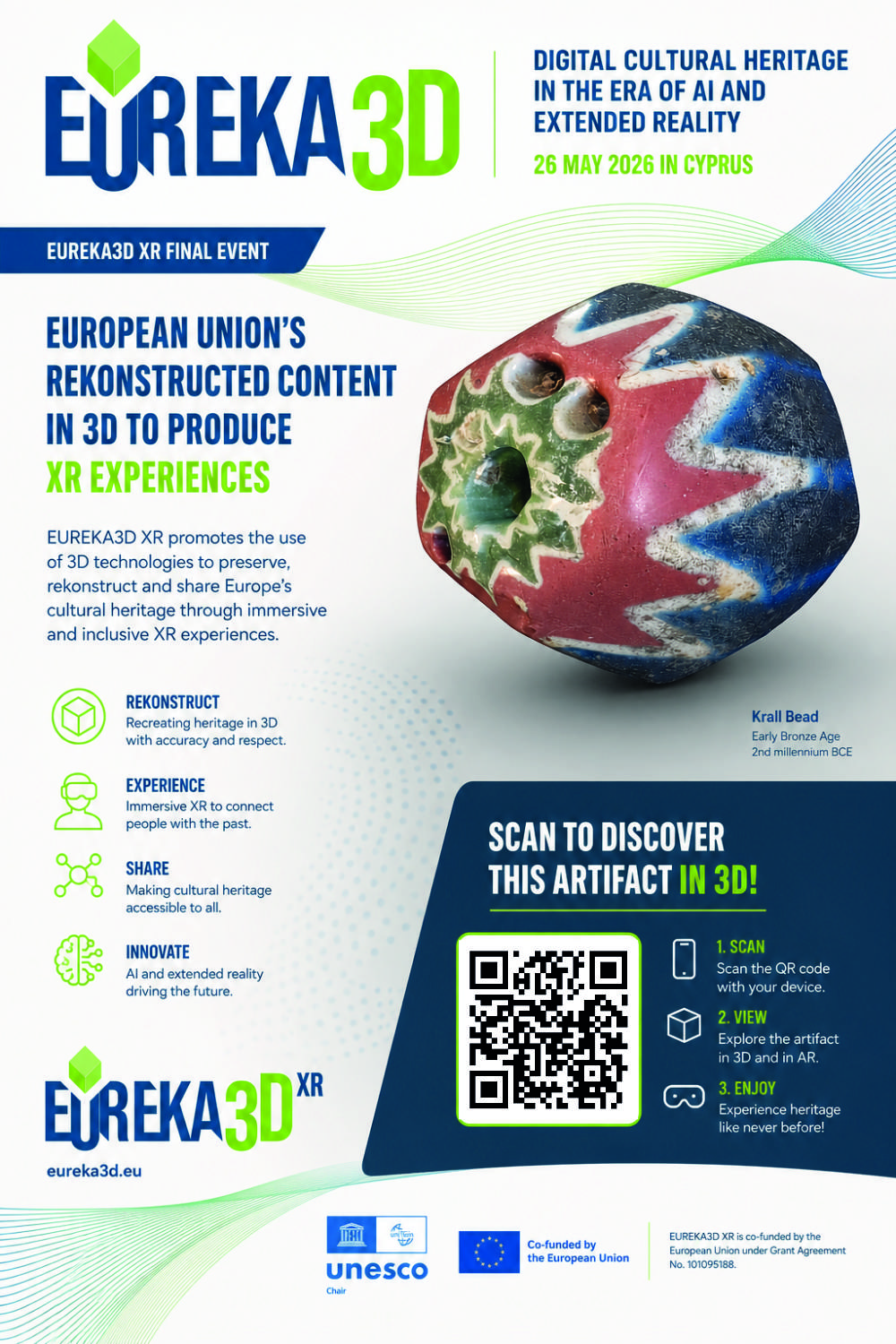
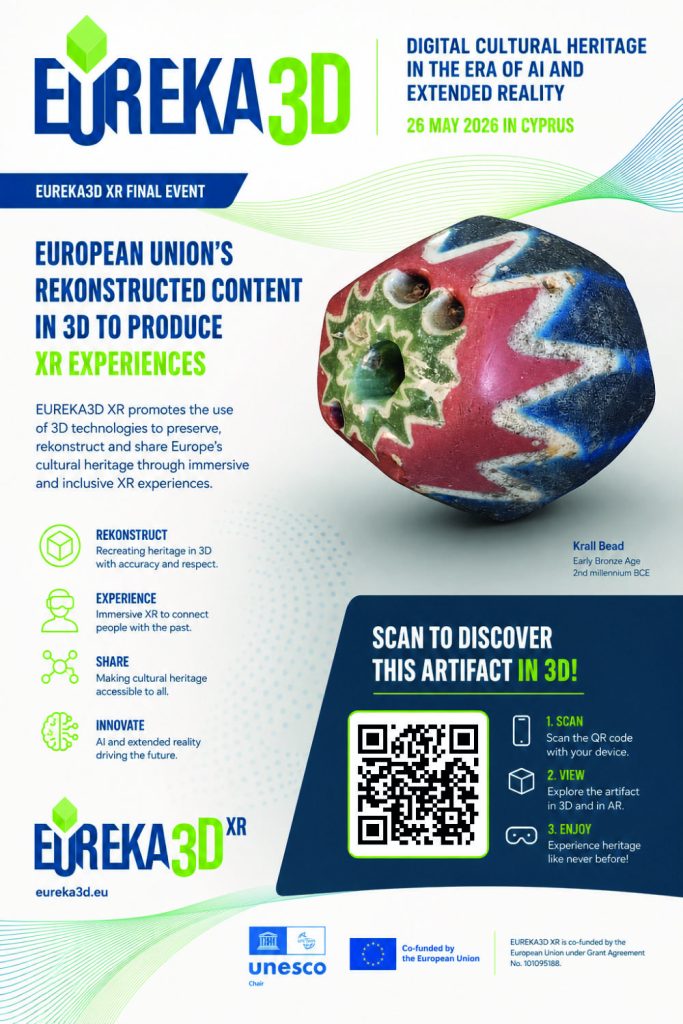
For our poster contribution, we wanted to explore that exact transition: how a printed image of a cultural artefact can become the starting point for an immersive 3D encounter. Rather than presenting the poster as a finished graphic object only, we designed it as a gateway into an XR experience. The printed poster works as both communication material and image target, allowing viewers to scan it with their phone and see a 3D artefact appear directly over the visual reference.
This work is part of our independent experimentation with 3D content, WebAR and cultural storytelling. Our aim is simple: to make digital heritage feel more tangible, more immediate and easier to access without requiring a headset, a dedicated app or specialist equipment.
From Poster to Interactive XR Experience
The poster was conceived as a bridge between traditional exhibition formats and real-time digital interaction. A reader can approach it as a normal printed poster, understand the concept, and then use a QR code to open the WebAR experience on their mobile browser.
Once the experience loads, the camera recognises the poster image and uses it as a tracking target. When the target is detected, the 3D artefact appears anchored to the poster surface. The viewer can then rotate the model with touch gestures, inspecting the object from different angles instead of seeing it only as a flat image.
This small interaction changes the relationship between audience and object. A printed poster usually asks the viewer to read. A 3D/XR poster asks the viewer to participate.
Why Image Tracking?
For this prototype, image tracking was the most appropriate technology because it creates a direct relationship between the physical poster and the digital artefact. The poster is not just a promotional surface; it becomes part of the interface.
The workflow follows a clear structure:
- A visual reference is prepared as the image target.
- The image target is integrated into a WebAR project.
- A 3D model is optimised for mobile viewing.
- The experience is published online.
- A QR code on the poster opens the experience directly in the browser.
- The user scans the poster and interacts with the 3D artefact.
The advantage of this approach is accessibility. Visitors do not need to install an app. They simply scan a QR code, allow camera access, and point their phone at the poster. For exhibitions, cultural events and educational settings, this lowers the barrier to entry considerably.
Making the Artefact Rotatable
One of the key decisions was to allow the 3D artefact to be rotated by the viewer. This may seem like a small technical feature, but it is essential for the experience.
A 3D object should not behave like a decorative overlay. It should invite inspection. Rotation gives the viewer control and encourages a slower, more curious way of looking. Instead of presenting the artefact from a single fixed angle, the interaction suggests that the object has volume, texture and presence.
In cultural heritage, this matters. Many artefacts are understood through their material qualities: shape, proportion, surface detail, damage, age, asymmetry and craftsmanship. Even when a digital model is simplified for mobile use, allowing the viewer to rotate it helps preserve part of that physical reading.
Technical Approach
The prototype was developed as a lightweight WebAR experience. The goal was not to create a complex application, but a stable and direct interaction that could run from a mobile browser during an event.
The main technical elements are:
- A printed poster used as the image target.
- A QR code linking to the online AR experience.
- A mobile-optimised 3D model from de store of Culture Heritage
- Browser-based camera access.
- Image tracking to align the model with the poster.
- Touch interaction to rotate the artefact.
- A clean interface with minimal distractions.
The visual design of the poster supports this interaction. It introduces the project, presents the artefact clearly, and guides the viewer towards the QR code. The AR layer then extends the poster instead of replacing it.